


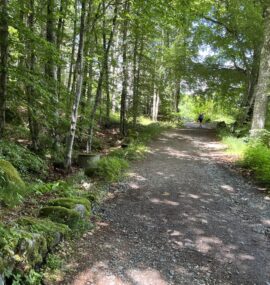
What is forest bathing?
In 1982, the Japanese Ministry of Agriculture, Forestry, and Fisheries coined the term shinrin-yoku. It refers to making contact with and taking in the atmosphere of a forest. Shinrin-yoku is also called forest bathing in the sense that a person is immersed in the forest, with attendant cleansing effects related to mental and physical relaxation. While it may sound odd to some Americans, the Japanese believe that simply being in a forest produces health benefits.
Activate your natural killer cells
Among the documented benefits are increased natural killer cell activity (these cells induce tumor cell death) and increased proportions of natural killer and T cells and proteins (all of which have anti-cancer activity). In one study, twelve apparently healthy men (mean age 43 years) spent three nights and two days in two forests. A variety of samples and measurements were taken from the subjects including blood samples, a Profile of Mood States questionnaire, activity using a pedometer, and sleep during a typical day at work before the forest visit and during and immediately following the forest visit. Eleven of the twelve subjects showed higher natural killer cell activity after the forest visit compared to during work. Forest bathing also increased the number of natural killer cells, as well as the number of other anti-cancer cells and proteins. These results suggest that frequent visits to a forest might reduce your risk of cancer.
Physiological and psychological benefits
A recent study supports the proposition that being in a forest promotes relaxation as evidenced by psychological and physiological changes. The study involved male undergraduate students at a Japanese university at 24 areas in Japan. In each area, 12 subjects with no reported history of physical or psychiatric disorders spent time sitting (about 14 minutes) and walking (about 16 minutes) in a forest (during one day) or in an urban environment (during an adjacent day). The subjects completed a Profile of Mood States Survey that assessed six dimensions of mood: tension / anxiety; depression / dejection; anger / hostility; fatigue; confusion; and vigor. Cortisol levels were analyzed from saliva samples. Heart rate variability and R-cardiac waves were measured with a portable electrocardiograph. Pulse and blood pressure were measured using oscilloscometric methods.
The researchers found that all six measures of mood before and after forest viewing or walking changed in the favorable direction (for example, less tension / anxiety) compared to urban viewing or walking. Similarly, salivary cortisol (a measure of stress), pulse rate, systolic and diastolic blood pressure, and the ratio of sympathetic to parasympathetic nervous system activity (a lower ratio indicates less stress) were significantly lower in after forest viewing or walking compared to urban viewing or walking.
This study supports other studies of shinrin-yoku as well as studies of human responses to forest environments relative to urban environments in other countries. All of the studies support the idea that forest environments reduce stress (for example, reduced cortisol, lower pulse) apparently by promoting relaxation. People who live in close proximity to forests have an opportunity to spend time in those forests by taking in the sights, sounds, and smells while sitting or walking. It’s tempting to speculate that exercising in a forest would provide addition benefits beyond those that would accrue from exercising in town.
Research in Taiwan showed that two hours of forest bathing in a nature education area promoted positive autonomic nervous system activity and emotions. The study include 128 middle-aged subjects (average age 60 years). More specifically, pulse rate, systolic and diastolic blood pressure, and anxiety all declined, while positive mood improved, after forest bathing.
Adults with hypertension benefit from forest bathing
Forest bathing appears to promote several aspects of better health including reduced psychological stress and better immune function. Forests emit volatile organic compounds that may benefit human health. Would older people with hypertension benefit from forest bathing? Researchers in China recruited 34 men and women (average 73 years) for a randomized trial to find out. Participants engaged in four activities (8 trigrams boxing, walking, tea ceremony, medication) either in a broad-leaf subtropical forest or in a large, busy urban area over a three-day period. Blood samples and psychological data were collected before and after the activities were completed. Compared to participants in the urban group, participants in forest bathing group showed significantly lower systolic, diastolic blood pressure, and high-sensitivity C-reactive protein (a measure of chronic inflammation) as well as greater heart-rate variability. These beneficial results suggest that regular periods of forest bathing might help resolve hypertension.
Would forest bathing help people with chronic obstructive pulmonary disease?
Chronic obstructive pulmonary disease (COPD) refers to persistent damage to the lungs that results in inflammation. Common manifestations include difficulty breathing, wheezing, and coughing up phlegm. COPD includes emphysema and chronic bronchitis. Researchers in Japan tested whether forest bathing would improve inflammatory markers associated with COPD and otherwise improve quality of life for patients at high risk of COPD. The study included 30 Japanese men with an average age of 63 years who scored high risk on a COPD screening questionnaire.
On the first day of the study day, all participants were driven to a hotel and ate the same meals. On the second day, the participants were randomized to one of 2 groups: forest bathing (walking 1.5 hours in the Akasawa Natural Recreation Forest) or urban walking (walking 1.5 hours in Ina City). On the third day, both groups switched group assignments. Both walking days featured fine weather. On the second and third days before and after walking, participants contributed blood samples (to analyze biomarkers), had their oxygen saturation measured, and answered questionnaires about their sleep, anxiety, fatigue, physical activity, and other aspects of physical and mental health.
After forest bathing, participants showed significantly improved levels of fibrinogen, C-reactive protein, interlukin-6, oxygen saturation, respiratory symptoms, and 4 out of 5 measures of subjective sleep quality, all of which denote better lung function compared to before forest walking. Forest walking induced significantly better levels of 6 of 8 measures of mood states and less fatigue. Both forest and urban walking significantly improved levels of fibrinogen, but only forest walking improved levels of 4 or 8 measures of mood states. In addition, compared to urban walking, forest bathing led to significantly better levels of interlukin-6, oxygen saturation, vigor and activity, and fatigue.
What might account for the positive effects of forest bathing? The answer might be better air quality in forests and the presence of chemicals (phytoncides), which are emitted by coniferous trees (such as cypress trees that live in the Akasawa Natural Recreation Forest). Researchers found phytoncides in the forest but not in the urban area. The air pollutants benzene, toluene, acetone, and xylene were present in the urban areas but not in the forest. Those of us who live in urban areas might do well to walk in nearby forests.
What to do
Those of us who live near forests can frequently spend time in those forests. Forest walking can provide two health benefits: greater physical activity and relief from daily stressors.

