Food addiction
The idea that ultra-processed foods could be addictive gained traction over the past decade. Ultra-processed foods now account for most of the calories ingested by Americans. Higher intakes of such foods predict increased risks of obesity and type 2 diabetes. A recent review concluded that ultra-processed foods are created in much the same manner as addictive products, such as cigarettes, that are specifically formulated to have unnaturally high levels of rewarding ingredients that are rapidly absorbed by the body and whose effects are enhanced by additives. The combination of high amounts of refined and rapidly absorbed carbohydrates and fat, complemented by salt, sweeteners, and other additives, may account for most food addiction. Similar to addictive drugs, some but not all persons show patterns of addiction through repeated use, with reduced control over consumption, intense cravings, and the inability to reduce consumption in spite of understanding the negative health consequences. Unlike addictive drugs, cessation of ultra-processed food consumption does not lead to life-threatening withdrawal symptoms.
The Yale Food Addiction Scale uses responses for a set of behaviorally related statements to ’diagnose’ the presence of food addiction. The statements are similar to those used in the American Psychiatric Association’s Diagnostic and Statistical Manual for Mental Disorders (DSM5). Thus, food addiction may be regarded as a substance-use disorder. The authors of the review believe that meaningful reduction in the adverse health effects of ultra-processed foods will require effective public health actions, such as taxes, limiting ultra-processed foods in school lunches, and limiting the marketing of ultra-processed foods especially to children.
Food addiction and type 2 diabetes in China
Given that poor diet predicts increased odds of having type 2 diabetes, would higher prevalence of food addiction predict greater odds of type 2 diabetes? Chinese researchers recruited 312 patients with newly diagnosed type 2 diabetes and 312 participants without type 2 diabetes matched to the patients with type 2 diabetes in terms of age and body mass index. Participants had an average age of 49 years. Participants were deemed food addicted if they exhibited at least 3 of the 8 symptoms of the Yale Food Addiction Scale. Food addiction occurred in 8.6 percent of the type 2 diabetics and in only 1.3 percent of the matched participants. In the same vein, 23.7 percent of the type 2 diabetics had 3 or more symptoms, compared to only 4.8 percent of the matched participants. Compared to the matched participants, the type 2 diabetics had significantly greater weight, waist circumference, waist-to-hip ratio, fasting blood glucose. Of the type 2 diabetics, those with food addiction had significantly greater weight, body mass index, waist circumference, waist-to-hip ratio, fasting blood glucose. In this sample of middle-aged Chinese people, food addiction predicted greater odds of type 2 diabetes and poorer metabolic health.
Food addiction and metabolic profile
According to some researchers, food addiction is a behavioral pattern that resembles addictions to alcohol and drugs. Researchers sought to determine relationships between type 2 diabetes, food addiction, and related clinical or psychological variables in patients with type 2 diabetes. Three hundred patients with type 2 diabetes were evaluated for the presence of food addiction per the Yale Food Addiction Scale 2.0 questionnaire. Food addiction occurred in 29.3 percent of the patients. Compared to non-food addicted patients, those with food addiction had significantly higher body mass index and higher blood sugar (measured as HbA1c). In addition, patients with food addiction had higher odds of diabetic retinopathy, neuropathy, nephropathy, and depressive symptoms. The presence of food addition in patients with type 2 diabetes may worsen their metabolic profile and other adverse health outcomes.
Food addiction and increased odds of type 2 diabetes
Consumption of ultra-processed foods, with precise combinations of sugar, salt, fat, and flavorings, can lead to addictive-type eating and weight gain in some people. Scientists in Denmark used cross-section data from a random sample of Danish residents (N=1,394, average age 34 years) and without (N=1,699, average age 43 years) clinically diagnosed mental disorders to determine if food addiction predicted the odds of having type 2 diabetes. Food addiction was evaluated with the widely used Yale Food Addiction Scale. 2.0, which consisted of 35 self-reported items.
After adjusting for age and sex and compared to participants in the general population, participants in the general population with food addiction were significantly more likely to have type 2 diabetes and a mental disorder. Each one point increase in the food addiction score predicted a significant 30 percent increase in the odds of type 2 diabetes. Participants with food addiction and mental disorders had statistically higher odds of type 2 diabetes. Limiting intake of ultra-processed foods, such as chips and cookies, may help you avoid type 2 diabetes. Or eating lots of junk food and having lots of body fat may increase your odds of type 2 diabetes.
Prevalence of food addiction in older American adults
Americans have embraced ultra-processed foods such that these foods comprise nearly 60 percent of dietary energy. Alas, diets high in ultra-processed foods predict increased risks of mortality, cardiovascular disease, and other maladies. Ultra-processed foods are so tasty that they trigger addiction-like responses in some people. Researchers at the University of Michigan used data from a nationally representative sample of 2,038 older adults (average age 64 years) to determine the prevalence of ultra-processed food addiction. Addiction was evaluated using a validated and modified Yale Food Addiction Scale 2.0, which included 13 statements each rated on an 8-point scale by participants.
Overall, 12 percent of women and 8 percent of men had ultra-processed food addition. Men and women who reported being overweight had 19 and 11 times (!) higher odds of having ultra-processed food addiction than men and women who reported having about the right weight. Compared to men and women who reported good to excellent physical health, men and women who reported fair or poor physical health had significant 199 and 93 percent higher prevalence of ultra-processed food addiction. Participants of both sexes between ages 50-64 had significantly higher prevalence of ultra-processed food addiction than participants aged 65-80. Ultra-processed food addiction is especially prevalent in overweight Americans with fair or poor health and predicts worse health.
What to do
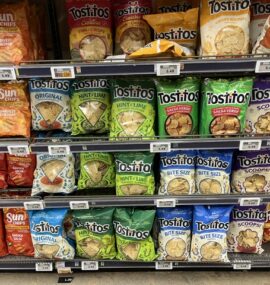
Eating some chips now and again probably won’t do you any harm. But a diet based on junk food probably will. Here’s a way to limit your purchases of ultra-processed foods that I have used successfully: At the grocery store, avoid the aisles loaded with junk food, such as sodas, chips, cookies, breakfast cereals, snack bars, and ice cream. Spend most of your food shopping time in the produce section.