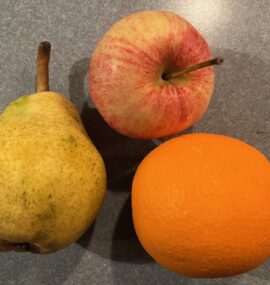
Eat more (types) of fruits and vegetables?
For years, health authorities have encouraged people to eat more fruits and vegetables (five a day) to reduce the risks of chronic diseases, such as type 2 diabetes. Researchers in the UK took a different tact by asking if a greater variety of fruits and vegetables predicted lower risk of type 2 diabetes. Data came 3,704 participants with an average age of 59 years in the EPIC-Norfolk cohort in England. At baseline, participants filled out daily food diaries for a week. The diaries included 58 types of fruit and 59 types of vegetables. Researchers calculated the number of fruit and vegetable portions, as well as the number of types of fruits and vegetables, consumed per week. The average participants ate 11.7 different fruits and vegetables combined per day.
After accounting for confounding factors and compared to participants in the lowest one-third of fruit, vegetable, and both fruit and vegetable portions eaten, participants in the highest one-third had significant 25, 28, and 32 percent lower risks, respectively, of developing type 2 diabetes during 11 years of follow-up. When fruit and vegetable variety were included in the statistical model, the total intake of fruits was no longer statistically related to diabetes risk. This finding suggests that variety of fruit and vegetable variety might matter as much or more than quantity with regard to diabetes risk.
With regard to fruit and vegetable variety, participants in the highest one-third of fruit, vegetables, and fruit plus vegetable consumption had significant 29, 27, and 40 percent lower risks of developing diabetes during follow-up. After accounting for fruit and vegetable quantity in the statistical model, the variety of fruits was still statistically related to diabetes risk. The health value of greater quantity and variety of fruits and vegetables might arise from their lower caloric levels and less risk of weight gain. The myriad of beneficial bioactive compounds (such as flavonoids) in fruits and vegetables could also explain their lower risk of diabetes. Alas, only one quarter of participants reported eating 5 or more servings of fruits and vegetables per day.
Eat a balanced diet?
Nutrition experts commonly advise people to eat a ‘balanced diet’ or to eat a ‘variety of healthy foods’. But that do these terms actually mean for people who want to avoid type 2 diabetes? Researchers in the UK used data from 23,238 participants with an average age of 58 years in the EPIC-Norfolk cohort to find out. Participants were given 1 point for every one of 5 major foods groups (dairy, fruit, vegetables, meat, grain) from which foods were consumed at least twice per week. In addition, participants were given 1 additional point for each food within each of the 5 major foods groups that participants consumed at least twice per week. Higher scores reflected higher dietary diversity with respect to the 5 major food groups and within each group.
After accounting for a host of confounding factors and compared to participants with the low dietary diversity scores (0-3), participants with the highest possible score (10) for the major food groups had a significant 30 percent lower risk of developing diabetes during an average follow-up of 10 years. Within the dairy, vegetable, and fruit food groups, participants with the highest possible score (3-6 depending on the group) had significant 39, 32, and 31 percent lower risks of developing diabetes compared to participants with low scores (0-1). Diversity in the meat and grain groups was not related to diabetes risk. Thus, eating several types of vegetables, fruits, and dairy products might reduce the risk of developing type diabetes.
Within healthy food group diversity?
A huge team of European researchers used data from 451,390 participants with a median baseline age of 51 years in the European Prospective Investigation into Cancer and Nutrition (EPIC) see if diets with high food biodiversity predict lower risks of all-cause and cause-specific mortality Food diversity was calculated as dietary species richness; that is, the absolute number of unique biological species in a participant’s diet. This means that all food products from the cattle (meat, milk, yogurt, whey protein powder) would count as 1 species, because they all come from a single species. Dietary species richness values, ranging from 40 to 89, were grouped in quintiles.
After accounting for confounding factors (established components of dietary quality) and compared to the lowest quintile of dietary species richness values (41), participants in the highest quintile (83) had a significant 37 percent lower risk of dying of any cause during a median follow-up of 17 years. The risk of all-cause mortality declined in a step-wise manner from quartile 1 to quartile 5, suggesting cause-and-effect. In addition, participants in quintile 5 had significantly lower risks of dying of cancer (25 percent), cardiovascular disease (44 percent), coronary heart disease (45 percent), respiratory disease (56 percent), and digestive disease (54 percent) compared to participants in quintile 1. Each 10-species incremental increase in dietary species diversity predicted significantly reduced risks of dying of the above diseases. Thus eating a wider variety of food species might improve overall health.
Dietary diversity questions
A group of French researchers summarized the current state of food variety ideas in a 2024 review. The term, diversity, does not have a single agreed-upon meaning among nutritionists. In fact, several ways to define diversity have been borrowed from the ecological literature. Should diversity reflect the relative quantities of food consumed? Should diversity include within food group diversity, or between group diversity, or both? What about food groups, such as meat and dairy, for which studies show conflicting results regarding health value? Should foods that are thought by many to be harmful, such as processed meats, be included in diversity measures? Should diversity measures exclude or include ultra-processed foods, which are generally regarded as unhealthful but which have proliferated in recent decades and now comprise over half of the calories in diets in developed countries? How would diversity reflect the presence of beneficial and non-beneficial phytochemicals in foods, especially fruits and vegetables? Should dietary diversity reflect the environmental impacts of the constituent foods?
Flavonoids
Flavonoids are complex organic molecules (thousands of different kinds) that occur in fruits, vegetables, legumes, nuts, red wine, and tea. Higher intakes of dietary flavonoids predict lower risks of all-cause mortality and chronic diseases. Different flavonoids provide different health benefits. Thus, researchers investigated whether greater diversity of flavonoid-containing plant foods would predict lower risks of all-cause mortality and chronic diseases. Research subjects included 124,805 participants with an average age of 60 years in the UK Biobank. Flavonoid intake data came from validated 24-hour dietary recall questionnaires completed on up to 5 occasions by each participant.
After accounting for confounding factors, both the highest quintile total flavonoid intake and the highest quintile of total flavonoid intake diversity predicted significant 16 and 14 percent reduced risk of all-cause mortality, respectively, compared to the lowest quintiles. Similarly, both total and flavonoid diversity predicted significant 6-20 percent lower risks of cardiovascular disease, type 2 diabetes, cancer mortality, respiratory mortality, and neurodegenerative disease.
What to do
Eating a diverse diet seems to be a good idea. But a large devil lies in the details. For now, the admonition to eat a variety of healthful foods, especially fruits, vegetables, legumes, nuts, seeds, and whole grains, seems sensible. How about developing the healthy habit of eating a variety of flavonoid-rich foods, such as green and black tea, berries, apples, oranges and grapes, every day?